

A CEO asked me a question the other day.
“Adrian, we spend €50,000/month on marketing. We bring in a lot of clients. But I don't know if we're making or losing money.”
I asked a simple question:
“Do you know how much EACH customer costs you?”
Silence.
"And how much do you earn from each client in TOTAL?"
More silence.
"So how do you know if it works?"
He replied, “Well… I don’t know. We just trust the accountant.”
That's the PROBLEM for 95% of companies in Andorra.
They spend money on marketing WITHOUT KNOWING if it works.
It's like traveling blindfolded.
In this post I'll teach you the 3 metrics that EVERY CEO should understand.
With them, you'll know EXACTLY if your marketing is scaling the business or burning money.
🎯 WHY DO THESE 3 METRICS MATTER?

Imagine you are the captain of an F1 team.
Your engineer tells you: “Today we traveled 300 km.”
Does it matter to you? No.
What matters to you is: “What was the time? Better or worse than yesterday? Is the engine optimized?”
The same thing happens in marketing.
Many CEOs are looking at:
- ❌ “We bring in 1000 leads/month”
- ❌ “We have 500k website visits”
- ❌ “The campaign reached 100k people”
But they DON'T look:
- ✅ How much does each lead cost?
- ✅ How much do I EARN from each customer?
- ✅ Is the marketing expenditure profitable?
Without these 3 metrics, you're flying blind.
With them, you have TOTAL CONTROL.
💰 METRIC #1: CAC – CUSTOMER ACQUISITION COST
WHAT IS IT IN SIMPLE LANGUAGE?
CAC = How much money you spend to bring in ONE new customer.
In other words: If you spend €10,000 on marketing and bring in 50 customers, your CAC is €200.
It costs you €200 to acquire EACH customer.
THE SIMPLE RULE:
Divide what you SPEND by the number of CUSTOMERS you bring in.
CAC = Total Spending ÷ New Customers
REAL EXAMPLES (VARIOUS):
EXAMPLE 1: Digital Marketing Agency
- Monthly spending: €8,000 (Google Ads, LinkedIn, events)
- New customers: 5
- CAC: €8,000 ÷ 5 = €1,600 per customer
(It makes sense: a B2B agency client is worth a lot, so a high CAC is normal)
EXAMPLE 2: 4★ Hotel in Andorra
- Monthly spending: €20,000 (Google Ads, Booking.com, Meta)
- New bookings: 100
- CAC: €20,000 ÷ 100 = €200 per booking
(Lower than agency, because there is more volume)
EXAMPLE 3: E-commerce of accessories
- Monthly spending: €5,000 (Meta Ads, Google)
- New customers: 250
- CAC: €5,000 ÷ 250 = €20 per customer
(Very low because it's volume)
EXAMPLE 4: Luxury Jewelry
- Monthly expenditure: €10,000 (Google Ads premium, Instagram)
- New customers: 8
- CAC: €10,000 ÷ 8 = €1,250 per customer
(High because the client has high value and is a niche market)
WHEN IS A CAC GOOD OR BAD?
It depends on the SECTOR. But here's the general guide:
If it's LOW (€50-€200) = ✅ Excellent
If it's MEDIUM (€200-€500) = 🟡 Acceptable
If it's HIGH (€500+) = ❌ Needs improvement
The key question: Does your CAC allow you to make money? (Spoiler: that depends on LTV)
💎 METRIC #2: LTV – LIFETIME VALUE (How Much You Earn From Each Customer)
WHAT IS IT IN SIMPLE LANGUAGE?
LTV = All the money you earn from ONE customer during their ENTIRE relationship with you.
It's not just the first purchase.
It is: First purchase + Future purchases + Recommendations + Long-term value.
CASE #1: HOTEL CUSTOMER
A customer who arrives via Google Ads:
- Visit 1: Room for 1 night (€250) + dinner (€100) + spa (€150) = €500
- Visit 2 (next year): 2 nights (€500) = €500
- Referral clients: Bring 2 friends (€500 each) = €1,000
- Future value in 3 years: 40% probability of returning a 3rd time (€300)
Total LTV: €500 + €500 + €1,000 + €300 = €2,300
CASE #2: E-COMMERCE CUSTOMER
A customer who buys accessories:
- Purchase 1: €50
- Purchase 2-4 (same 12 months): €120 (3 purchases of €40)
- Year 2: Keep buying €100
- Year 3: Stop buying (churn)
- Recommendations: Bring 1 friend who spends €150
Total LTV: €50 + €120 + €100 + €150 = €420
CASE #3: AGENCY CLIENT
A B2B client who contracts services:
- Months 1-3: Initial contract €5,000
- Month 4-12: Maintains monthly services €2,000 × 9 = €18,000
- Year 2: Renew + upgrade (€25,000)
- Recommendations: Bring in 2 new customers × €10,000 = €20,000
Total LTV: €5,000 + €18,000 + €25,000 + €20,000 = €68,000
THE SIMPLE RULE:
Multiply: (What a customer spends) × (How many times they buy per year) × (Years they remain a customer)
LTV = Average Ticket × Purchase Frequency × Years of Relationship
EXAMPLE TO CALCULATE YOURS:
One of your clients:
- Spend €500 on your first purchase
- Buy 2 times a year
- It lasts 3 years as a customer
€500 × 2 × 3 = €3,000
Your LTV is €3,000 per customer.
Each customer generates a total of €3,000 for you.
🔗 THE CONNECTION: CAC vs LTV
This is where EVERYTHING makes sense.
EXAMPLE: IS IT A GOOD BUSINESS?
Marketing Agency:
- CAC: €1,600
- LTV: €68,000
- Ratio: €68,000 ÷ €1,600 = 42.5
Is it a good business? YES. EXCELLENT.
For every €1 you spend, you earn €42.50.
E-commerce:
- CAC: €20
- LTV: €420
- Ratio: €420 ÷ €20 = 21
Is it a good business? YES. VERY GOOD.
For every €1 you spend, you earn €21.
Hotel (If CAC is good):
- CAC: €250
- LTV: €2,300
- Ratio: €2,300 ÷ €250 = 9.2
Is it a good business? YES. EXCELLENT.
For every €1 you spend, you earn €9.20.
📈 METRIC #3: ROAS – RETURN ON AD SPEND (Immediate Return)
WHAT IS IT IN SIMPLE LANGUAGE?
ROAS = For every €1 you spend on advertising, how much IMMEDIATE MONEY did you generate.
Difference with LTV: LTV is LONG TERM. ROAS is THIS MONTH.
THE SIMPLE RULE:
Divide what you EARNED in revenue by what you SPENT on advertising.
ROAS = Revenue This Month ÷ Advertising Spend
EXAMPLES:
EXAMPLE 1: Hotel that spends €20k and generates €60k in immediate revenue
€60,000 ÷ €20,000 = 3
Your ROAS is 3x (or “3 times your investment”).
For every €1 you spent, you earned €3 in revenue.
EXAMPLE 2: Agency that spends €10k on ads, brings in clients worth €25k immediately
€25,000 ÷ €10,000 = 2.5
Your ROAS is 2.5x
For every €1 you spent, you earned €2.50 in revenue.
EXAMPLE 3: E-commerce that spends €3k on ads, generates €9k in sales
€9,000 ÷ €3,000 = 3
Your ROAS is 3x
For every €1 you spent, you earned €3 in revenue.
WHAT IS THE MINIMUM VIABLE ROAS?
4x+ = 🟢 Excellent (scale as much as you can)
3x to 4x = 🟢 Very good (scales with confidence)
2x to 3x = 🟡 Acceptable (works, but can be optimized)
1.5xa 2x = 🟡 Marginal (check numbers, optimize)
1x or less = 🔴 CRISIS (stops immediately)
🎯 REAL CASE: COMPLETE TRANSFORMATION
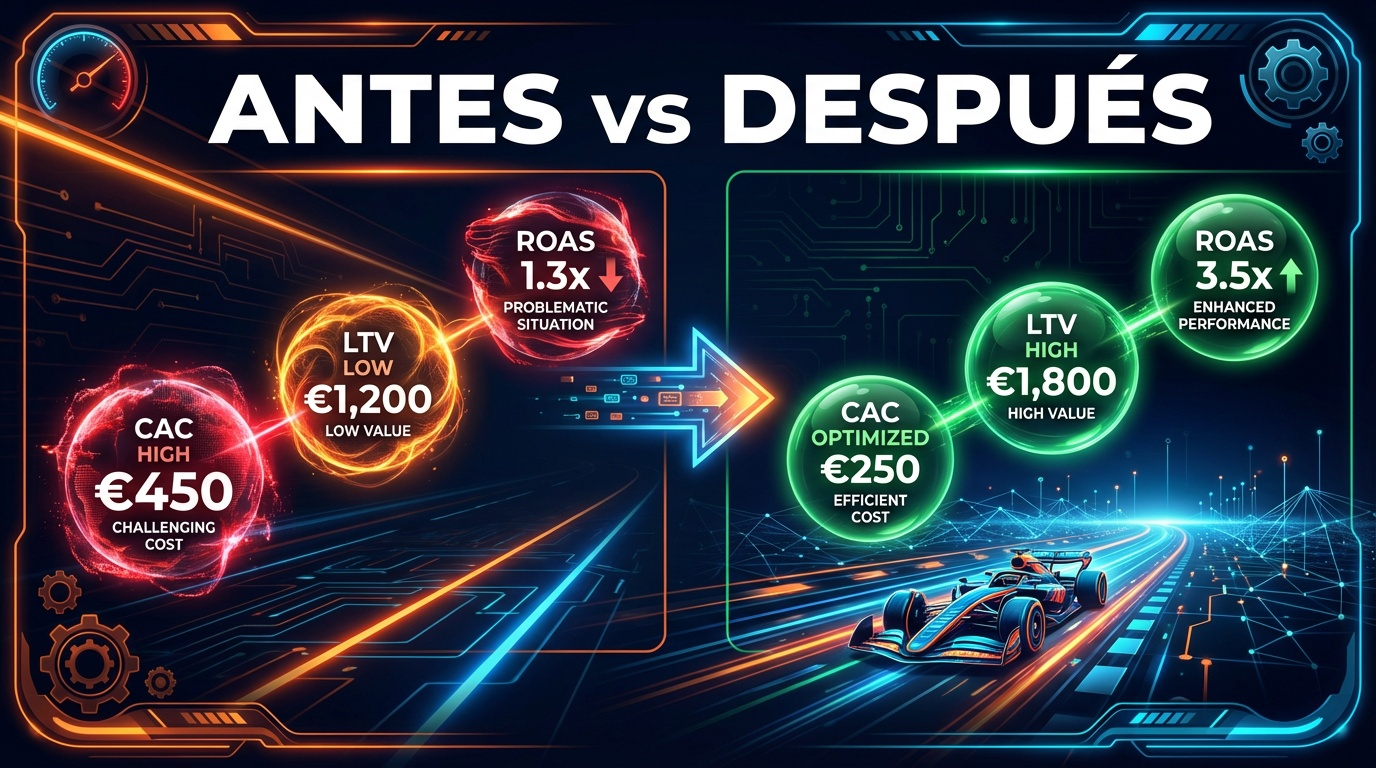
So you can see how these 3 numbers transform together:
BEFORE (6 months ago):
A company in Andorra (we've changed the sector to make it generic):
CAC: €450
LTV: €1,200
Ratio: €1,200 ÷ €450 = 2.6 (INSUFFICIENT)
ROAS: 1.3x (BURNING MONEY)
Interpretation: They spent €50,000/month, brought in expensive clients, and earned little from them.
Result: -€10,000/month loss
INTERVENTION (What we did):
- We lowered the CAC from €450 to €280 (-38%)
How:
- We audit each channel (which one brings in good/bad customers)
- We're killing inefficient channels
- We optimize landing page (conversion +25%)
- We improved targeting (we advertise to the right people)
- We increased LTV from €1,200 to €2,800 (+133%)
How:
- We create automated post-purchase emails
- We implemented a VIP/referrals program
- We offer complementary packages
- We maintained regular contact (email marketing)
To see how: Email Sequences That Convert (https://copilotsandorra.com/blog/email-sequences-conversion/)
- FINAL SCORE:
CAC: €280 (-38%)
LTV: €2,800 (+133%)
Ratio: €2,800 ÷ €280 = 10 (EXCELLENT)
ROAS: 3.7x (+185%)
Interpretation: Same budget (€50k), but now they bring in MANY more clients.
They earn MUCH more from each one.
Result: +€135,000/month of additional profit
FROM €50k SPENT TO -€10k LOSS → €185k PROFIT. SAME BUDGET.
That's not luck.
It's a SYSTEM.
🚨 WHAT IF YOUR NUMBERS ARE BAD?
If your ratio is less than 4 or your ROAS is less than 2x, there are 2 paths:
PATH 1: LOW CAC
Concrete actions:
✅ Audit each channel: which one brings in better customers?
✅ Eliminates inefficient channels (high cost, low return)
✅ Scale efficient channels (low cost, high results)
✅ Improve landing page (more people convert)
✅ Segment your audience (advertise to the RIGHT people)
✅ Optimize creative (copy + design that converts more)
Expected impact: CAC -30% to -60%
ROUTE 2: LTV UP
Concrete actions:
✅ Automated post-purchase email (keep in touch)
✅ Referral program (customer brings friends)
✅ Upsells/Cross-sells (sell more accessories)
✅ VIP program (loyalty benefits)
✅ Membership/Recurrence (converts one-off purchases into recurring ones)
For specific implementation: Email Sequences That Convert (https://copilotsandorra.com/blog/email-sequences-conversion/)
Expected impact: LTV +50% to +200%
PATH 3: BOTH (THE WINNING OPTION)
Lower CAC + Higher LTV = EXPONENTIAL TRANSFORMATION
That's what makes the difference.
That's what gives you a competitive edge.
To see how we do it comprehensively: Business Strategy Guide 2026 (https://copilotsandorra.com/blog/guia-estrategia-empresarial-andorra/)
🔧 HOW TO CALCULATE YOUR NUMBERS RIGHT NOW (WITHOUT COMPLICATED FORMULAS)
Open Excel. I'll explain it to you step by step, like you're going to school:
STEP 1: CALCULATE YOUR CAC (How much each customer costs you)
The simple rule:
Divide what you SPEND by the number of CUSTOMERS you bring in.
CAC = Total Spending ÷ New Customers
Example:
You spent €8,000 on advertising this month.
You brought in 10 new customers.
€8,000 ÷ 10 = €800
Your CAC is €800 per customer.
It costs you €800 to bring in EACH new customer.
STEP 2: CALCULATE YOUR LTV (How much you earn from each customer)
The simple rule:
Multiply: (What a customer spends) × (How many times they buy per year) × (Years they remain a customer)
LTV = Average Ticket × Purchase Frequency × Years of Relationship
Example:
One of your clients:
- Spend €500 on your first purchase
- Buy 2 times a year
- It lasts 3 years as a customer
€500 × 2 × 3 = €3,000
Your LTV is €3,000 per customer.
Each customer generates a total of €3,000 for you.
STEP 3: IS IT A GOOD BUSINESS? (Compare CAC vs LTV)
The simple rule:
Divide the LTV by the CAC.
If the result is 4 or more = ✅ Good business
If it's 2 or less = ❌ Bad, needs improvement
LTV ÷ CAC = Ratio
Example:
€3,000 ÷ €800 = 3.75
For every €1 you spend, you earn €3.75.
It's a good business, although it could be improved (ideally 4 or more).
STEP 4: CALCULATE YOUR ROAS (How much you earned this month in revenue)
The simple rule:
Divide what you EARNED in revenue by what you SPENT on advertising.
ROAS = Revenue This Month ÷ Advertising Spend
Example:
You spent €10,000 on ads this month.
Those ads generated €30,000 in sales/revenue.
€30,000 ÷ €10,000 = 3
Your ROAS is 3x (or “3 times your investment”).
For every €1 you spent, you earned €3 in revenue.
📊 QUICK REFERENCE TABLE
WHAT DOES EACH NUMBER MEAN?
CAC €200 = It costs you €200 to bring in each customer
LTV €2,000 = Each customer generates a total of €2,000 for you
LTV ÷ CAC = 10 = For every €1 spent, you earn €10
ROAS 3x = For every €1 spent, you earned €3 in revenue
WHEN IS IT GOOD OR BAD?
ACC:
- If it's LOW (€50-€200) = ✅ Excellent
- If it's MEDIUM (€200-€500) = 🟡 Acceptable
- If it's HIGH (€500+) = ❌ Needs improvement
LTV:
- If it's HIGH (a lot of money) = ✅ Excellent
- If it's LOW (little money) = ❌ Problem
LTV ÷ CAC (The final number):
- If it's 4 or more = ✅ Very good business
- If it's 2 to 4 = 🟡 Acceptable
- If it's less than 2 = ❌ Bad deal
ROAS:
- If it's 3x or more = ✅ Excellent
- If it's 2x to 3x = 🟡 It works
- If it's 1x or less = ❌ You lose money
REAL-WORLD CALCULATED EXAMPLES (WITHOUT STRANGE FORMULAS):
EXAMPLE 1: Marketing Agency
- Spends €5,000/month on advertising
- Bring in 3 new customers
- CAC = €5,000 ÷ 3 = €1,667 per customer
- Each customer spends €10,000 in the first year
- And renew 2 more times (€20,000 in 3 years total)
- LTV = €20,000
- Ratio = €20,000 ÷ €1,667 = 12
- ✅ For every €1 spent, earn €12. EXCELLENT.
EXAMPLE 2: Hotel
- Spends €20,000/month on advertising
- Bring 80 reservations
- CAC = €20,000 ÷ 80 = €250 per booking
- Each booking generates €300 (room + services)
- The customer returns 1.5 times more in 3 years (€450 more)
- LTV = €300 + €450 = €750
- Ratio = €750 ÷ €250 = 3
- 🟡 For every €1 spent, earn €3. Acceptable, but could be improved.
EXAMPLE 3: E-commerce
- Spends €3,000/month on advertising
- It brings in 150 customers
- CAC = €3,000 ÷ 150 = €20 per customer
- Each customer spends €50 (first purchase)
- Purchases twice more per year = €150 total
- LTV = €150
- Ratio = €150 ÷ €20 = 7.5
- ✅ For every €1 spent, earn €7.50. VERY GOOD.
🎯 THE FINAL EXERCISE: Calculate YOUR numbers
Open Excel and fill this in:
My Business (This Month):
- How much did I spend on advertising?
€_ - How many new clients did I bring in?
- CALCULATE YOUR CAC:
Expenses ÷ Customers = € ÷ = €_ - How much does the average customer spend?
€_ - How many times a year do you shop?
_ times - How old is the average customer?
_ years - CALCULATE YOUR LTV:
Expenditure × Times × Years = € × × = € - CALCULATE YOUR RATIO:
LTV ÷ CAC = € ÷ € = _ If it's 4 or more = ✅ Good business
If it's 2 to 4 = 🟡 Acceptable
If it's less than 2 = ❌ Needs improvement - How much did you earn in income?
€_ - CALCULATE YOUR ROAS:
Income ÷ Expenses = € ÷ € = _________x If it is 3x+ = ✅ Excellent
If it's 2x-3x = 🟡 It works
If it is less than 2x = ❌ Problematic
🎯 HOW THESE NUMBERS CONNECT WITH THE REST OF YOUR STRATEGY
These numbers do NOT exist in isolation.
They're connected to your entire business:
If CAC is high:
→ Problem: Your offer is unclear, or your website doesn't convert.
→ Solution: Strategic Web Design 2026 + Strategic Branding
If LTV is low:
→ Problem: Customers don't return, there is no retention
→ Solution: Email Sequences That Convert + Sales Automation
If ROAS is low:
→ Problem: You're spending on the wrong channels
→ Solution: SEO Web Positioning + Digital Advertising
If everything is low:
→ Problem: Your complete strategy is fragmented
→ Solution: Business Strategy Guide 2026
Here's the inconvenient truth:
95% of companies in Andorra DO NOT KNOW their real numbers.
They spend money blindly.
We hope YOU are not that 95%.
❓ FREQUENTLY ASKED QUESTIONS – METRICS EXPLAINED SIMPLY

WHAT IS ROI (Return On Investment)?
ROI = Return on your Investment.
In other words: Of everything you spend on marketing, how much NET money do you earn?
SIMPLE FORMULA:
(Profit – Investment) ÷ Investment × 100 = ROI%
EXAMPLE:
You invest €1,000 in ads.
You earn €3,000 in sales.
Net profit: €3,000 – €1,000 = €2,000
ROI = (€2,000 ÷ €1,000) × 100 = 200%
That means: You earned 200% on your investment.
Or simply put: For every €1 you spent, you earned €2 NET.
WHAT IS ROAS (Return On Ad Spend)?
ROAS = Return on Advertising Spend.
It's the TOTAL MONEY you generate (not the net profit) for every €1 spent on ads.
DIFFERENCE WITH ROI:
- ROAS = gross cash ÷ expenses (does not include operating expenses)
- ROI = net profit ÷ expenses (after deducting costs)
SIMPLE FORMULA:
Revenue Generated ÷ Ad Spend = ROAS
EXAMPLE:
You spend €10,000 on Google Ads.
Those ads generate €30,000 in sales.
ROAS = €30,000 ÷ €10,000 = 3
That means: ROAS 3x (or “3 times your investment”).
For every €1 you spent, you generated €3 in revenue.
NOTE: The €30,000 still needs to be reduced by operational costs (employees, inventory, etc.).
Therefore, ROAS 3x does NOT mean 3x profit. But it is a good indicator that the campaign is working.
WHAT IS CAC (Cost of Customer Acquisition)?
CAC = Customer Acquisition Cost.
In other words: How much money do you spend to bring in ONE new customer?
SIMPLE FORMULA:
Total Marketing Spend ÷ New Customers = CAC
EXAMPLE:
You spend €5,000 on Facebook Ads this month.
Those ads bring in 20 new customers.
CAC = €5,000 ÷ 20 = €250
That means: It costs you €250 to acquire EACH new customer.
IS IT GOOD OR BAD?
It depends on the sector and the LTV (see below).
But as a general rule:
- If CAC < €100 = Very good
- If CAC between €100-€500 = Normal
- If CAC > €500 = High (needs improvement)
WHAT IS LTV (Lifetime Value)?
LTV = Customer Lifetime Value.
In other words: All the money you earn from ONE customer during their ENTIRE relationship with you.
It's not just the first purchase. It's future purchases, recommendations, total value.
SIMPLE FORMULA:
(Average Ticket × Purchase Frequency/Year × Years as a Customer) = LTV
EXAMPLE:
One of your clients:
- Spend €100 on your first purchase
- Buy 3 times a year
- He has been a customer for 4 years
LTV = €100 × 3 × 4 = €1,200
That means: That client will give you a TOTAL profit of €1,200 over 4 years.
WHY DOES IT MATTER?
Because if your CAC is €250 and your LTV is €1,200:
Ratio = €1,200 ÷ €250 = 4.8
It means: For every €1 you spend acquiring a customer, you earn €4.80.
EXCELLENT business.
WHAT IS THE DIFFERENCE BETWEEN CAC, LTV, ROAS AND ROI?
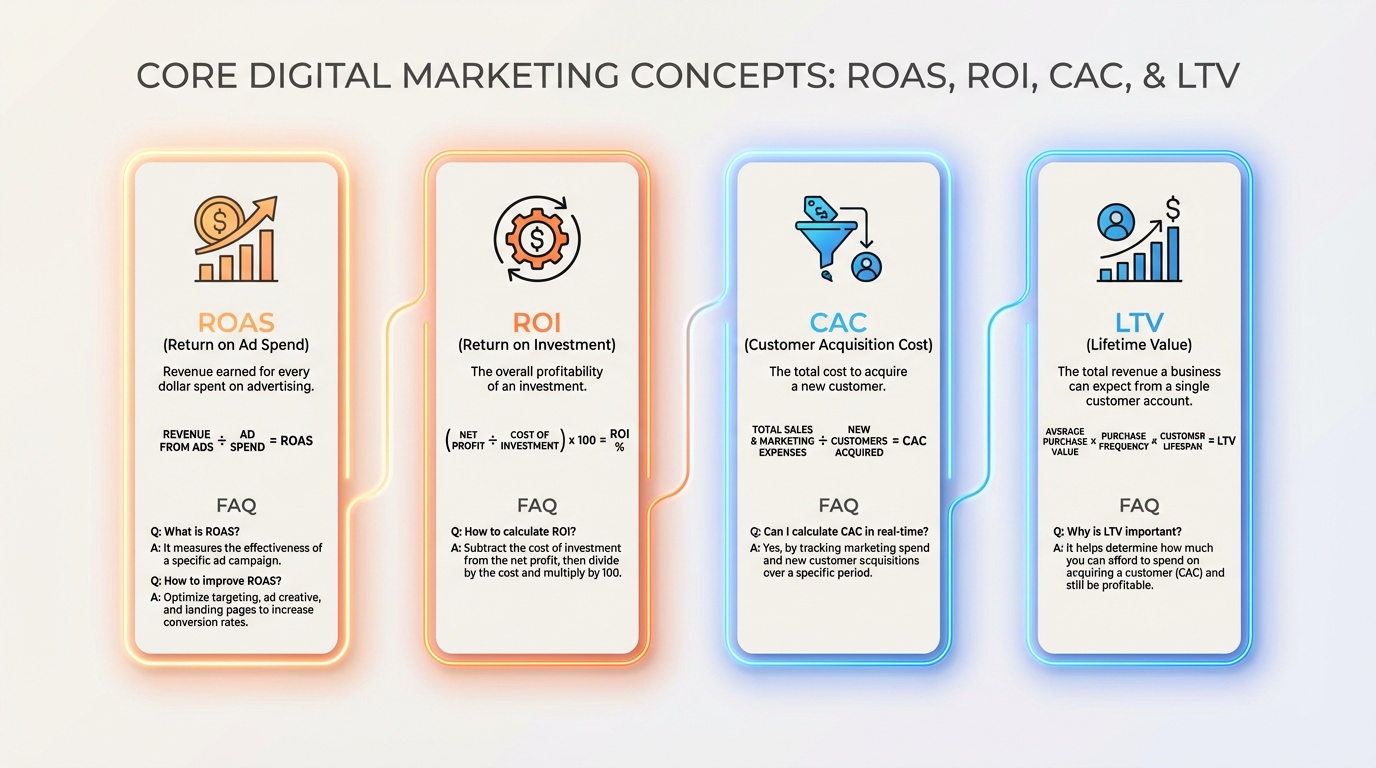
QUICK TABLE:
| Metric | What does it measure? | When | Example |
|---|---|---|---|
| CAC | How much does it cost to bring in 1 customer? | Acquisition | It costs you €200/customer |
| LTV | How much do you earn from 1 client (total) | Lifetime | You earn €2,000 per client in 3 years |
| ROAS | Money generated ÷ ad spend | This Month | €30k income ÷ €10k expenses = 3x |
| ROI | Net profit ÷ expenses | This Month | (€3k profit ÷ €1k expense) × 100 = 300% |
ORDER OF IMPORTANCE:
1️⃣ FIRST: CAC vs LTV (Is it a good long-term business?)
2️⃣ SECOND: ROAS (is it working this month?)
3️⃣ THIRD: ROI (How much net profit do I make after costs?)
WHICH NUMBER IS MOST IMPORTANT: CAC, LTV, ROAS OR ROI?
The short answer: CAC vs LTV.
BECAUSE:
- If your CAC/LTV RATIO is good (4 or more), everything else will fall into place.
- If your RATIO is bad, ROAS and ROI will never save the business.
EXAMPLE:
BUSINESS A:
- ROAS excellent: 5x
- BUT CAC €500 and LTV €1,000
- Rating: 2 (BAD)
- Result: Unsustainable business in the long term. Even though ROAS may seem good.
BUSINESS B:
- ROAS normal: 2.5x
- BUT CAC €150 and LTV €2,000
- Rating: 13.3 (EXCELLENT)
- Result: Very healthy business. ROAS is low but scalable.
📊 COMPARISON: WHAT SHOULD YOU MONITOR?
DAILY:
✅ ROAS (Are campaigns working today?)
WEEKLY:
✅ CAC (how much does each customer cost us?)
MONTHLY:
✅ LTV (How much do customers we brought in 3-6 months ago earn?)
✅ Net ROI (after deducting all costs)
QUARTERLY:
✅ CAC/LTV RATIO (Is the business sustainable?)
🎯 THE FINAL QUESTION
If you could ONLY monitor ONE metric, what would it be?
LTV.
Because if your LTV is high, you can spend more on CAC.
If your LTV is low, no amount of low CAC will save your business.
LTV is the metric that CONTROLS EVERYTHING.
Now that you know WHAT these metrics are, the question is: Do you know YOURS?
If the answer is “no”, you have 2 options:
OPTION 1: Calculate and optimize them YOURSELF
If you have an internal team:
→ Calculate your numbers now (use the Excel above)
→ Read Business Strategy Guide 2026
→ Implement Email Sequences to increase LTV
→ Improve Web Design to lower CAC
OPTION 2: Let's do it together (The fastest option)
If you need RESULTS IN 90 DAYS:
The AI Strategic Scanner will tell you:
✅ Your actual CAC (per channel)
✅ Your actual LTV
✅ Your current ROAS
✅ Where is the money?
✅ Exact action plan (90 days)
✅ Real scaling potential
Response within 24 hours. No obligation.
“Your business has hidden money. These 3 metrics are the treasure map. Will you use it?”
